Stem cell therapy is a regenerative treatment that introduces cells capable of supporting the body’s own repair response into an area of injury or degeneration. Clinics use it most often for joint pain and soft tissue injury. Regulatory status varies by product, and most applications remain investigational in the United States.
What Are Stem Cells and Why Do They Matter?
Stem cells are undifferentiated cells that can develop into specialized cell types and signal surrounding tissue to repair. Their value in clinical use comes from 3 properties.
- Differentiation: the capacity to become cartilage, bone, or connective tissue cells.
- Signaling: the release of growth factors that recruit the body’s own repair cells.
- Immune modulation: influence on the local inflammatory environment.
Signaling activity accounts for much of the observed effect, which is why related therapies focus on cell-derived messengers rather than cells alone.
Where Do the Cells Come From?
Clinical stem cell products come from 3 primary sources.
- Bone marrow aspirate, drawn from the patient’s iliac crest.
- Adipose tissue, harvested from the patient’s own fat.
- Perinatal tissue products, derived from donated umbilical cord or amniotic tissue.
Autologous sources use the patient’s own cells and avoid donor matching. Perinatal products are regulated differently and are subject to specific FDA rules on manufacturing and marketing.
How Does a Stem Cell Treatment Work?
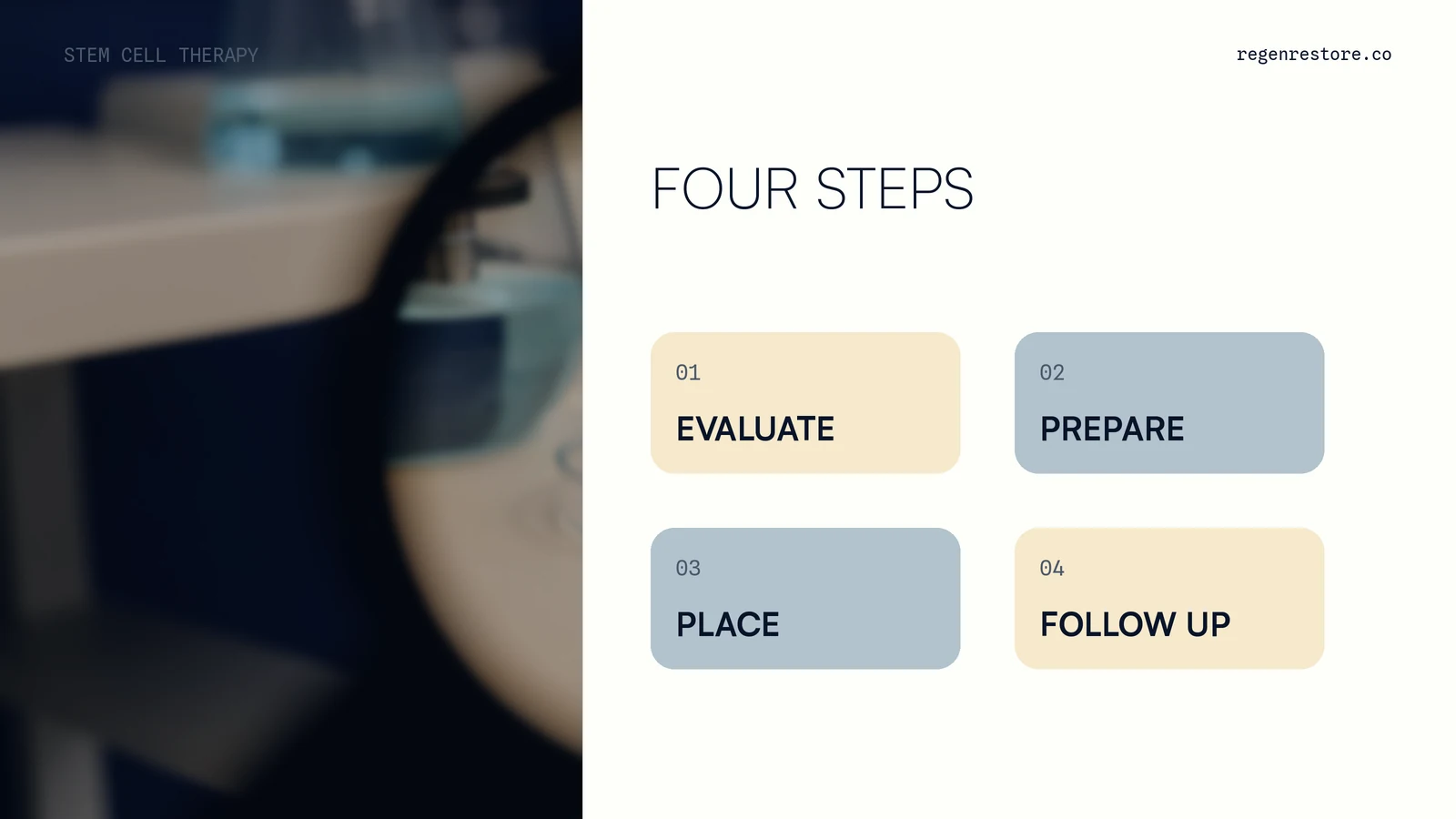
Treatment follows 4 steps from consultation to follow-up.
- Evaluation, including imaging and a review of prior treatments.
- Collection or preparation of the cell product.
- Image-guided injection into the target joint or tissue.
- Staged follow-up over 3 to 6 months to track function and symptoms.
The biological mechanism is covered in detail in how does stem cell therapy work, including the role of growth factors after injection.
What Conditions Are Patients Treated For?
Patients most commonly pursue treatment for knee osteoarthritis, rotator cuff and shoulder pain, chronic low back pain, and tendon injuries that have not responded to conservative care.
Is It a Replacement for Surgery?
No. Regenerative treatment is not a substitute for joint replacement in advanced structural disease. It is generally considered by patients seeking to delay surgery or by those who are not surgical candidates.
What Should Patients Know About Safety and Regulation?
The FDA regulates cell and tissue products, and most stem cell applications outside approved blood and immune conditions are considered investigational. Reputable clinics disclose that status openly and do not promise cures. Screening, sterile processing, and image guidance reduce procedural risk.
Our full discussion of screening and adverse event risk appears in is stem cell therapy safe.
How Does Stem Cell Therapy Compare to PRP?
PRP concentrates platelets and growth factors from the patient’s own blood, while stem cell therapy introduces cells with the additional capacity to differentiate. Three practical differences guide the choice.
- Cost: PRP is significantly less expensive per treatment.
- Preparation: PRP requires only a blood draw and centrifuge cycle.
- Application: PRP is often used first for tendon and early joint changes.
Many patients begin with PRP and consider cell-based treatment only if the response is incomplete.
What Does Treatment Cost?
Stem cell therapy is a cash-pay treatment at nearly every clinic in the country, since insurers classify most applications as investigational. Pricing depends on cell source, the number of sites treated, and whether imaging is included. See how much does stem cell therapy cost for current ranges and what each line item covers.
Candidacy is determined during evaluation. Our stem cell treatment program includes imaging review, a written treatment plan, and structured follow-up.
Frequently Asked Questions
How long does it take to see results?
Most patients report change between 6 and 12 weeks, with continued improvement through month 6. Response varies with the severity of degeneration, age, and activity level, and a portion of patients see no meaningful change.
Is stem cell therapy painful?
The injection is performed with local anesthetic and is generally well tolerated. Bone marrow aspiration adds soreness at the harvest site that typically resolves within 1 week.
Does insurance cover stem cell therapy?
Coverage is rare because most applications are classified as investigational. Details, including what documentation to request, are covered in is stem cell therapy covered by insurance.