
Stem cell therapy is a cash-pay treatment at nearly every clinic in the United States, because insurers classify most applications as investigational. Cost varies widely by cell source, the number of sites treated, and what the quote actually includes. Two quotes for the same joint can differ substantially and both be legitimate.
Why Is It Not Covered by Insurance?
Coverage is rare because the FDA considers most stem cell applications outside approved blood and immune conditions to be investigational. Insurers follow that classification.
Three consequences follow for patients.
- Treatment is paid out of pocket at time of service.
- HSA and FSA eligibility depends on your plan administrator, not the clinic.
- Financing is offered by many clinics as a separate arrangement.
The coverage question is addressed in detail in is stem cell therapy covered by insurance.
What Are the 6 Cost Drivers?
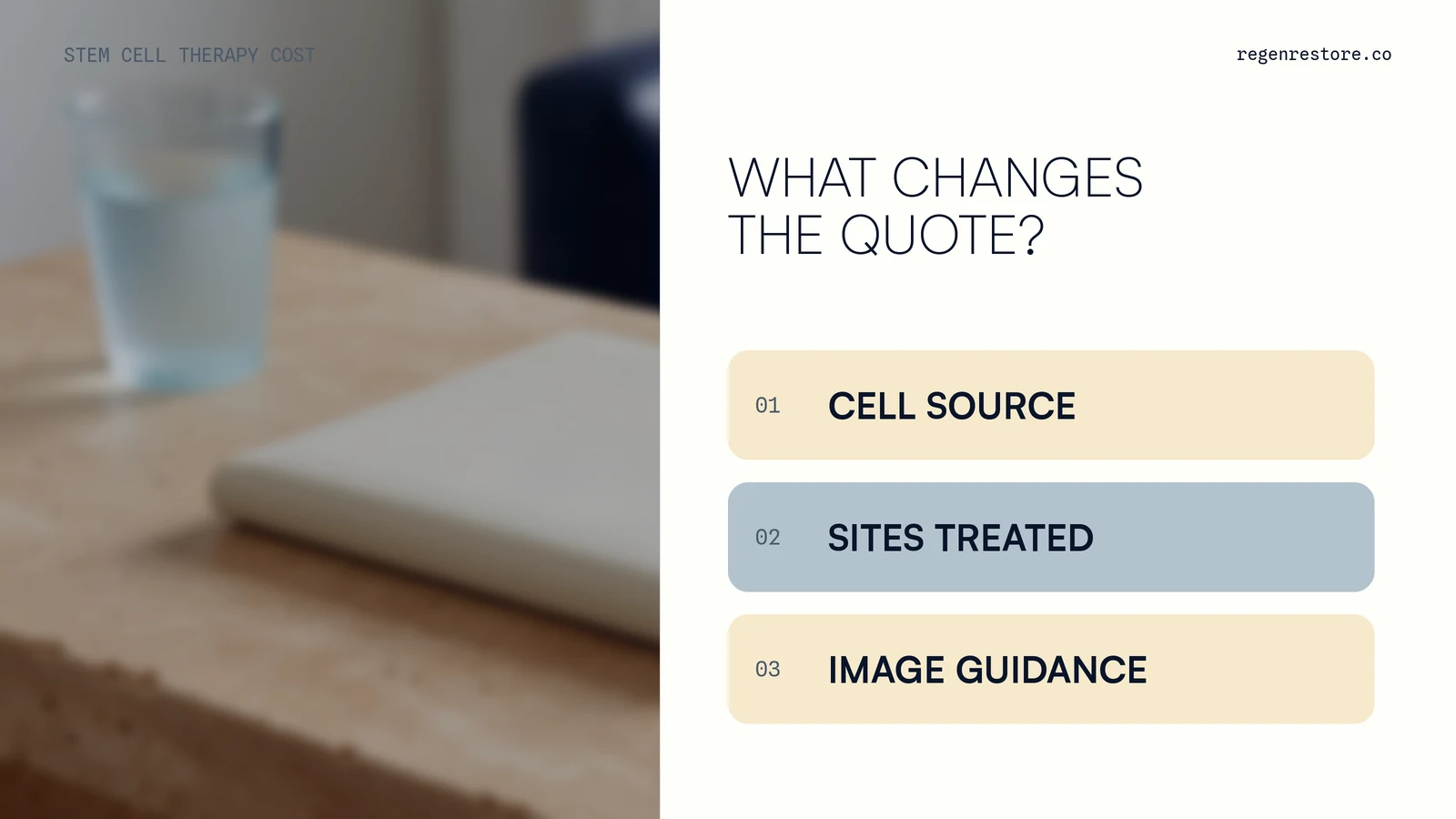
Six variables determine the number on a quote.
- Cell source, since bone marrow, adipose, and perinatal tissue products carry different acquisition and processing costs.
- Number of sites treated in a single visit.
- Cell count or dose delivered.
- Imaging guidance, and whether ultrasound or fluoroscopy is included.
- Harvest procedure, when autologous cells require bone marrow aspiration or a fat harvest.
- Follow-up visits and repeat imaging included in the plan.
Site count is the driver patients underestimate most. Treating both knees is not double one knee, but it is not the same as one either.
What Should a Quote Itemize?
A quote worth comparing separates 5 line items rather than presenting a single number.
- Consultation and imaging review.
- Cell product and processing.
- Procedure and image guidance.
- Facility or anesthesia fees when applicable.
- Follow-up visits across the first 6 months.
Ask whether repeat treatment is included or billed separately if the first round produces partial response. That single question changes the real cost of a course.
Why Do Quotes Vary So Much Between Clinics?
Wide variation reflects real differences in what is being delivered. Cell source, dose, imaging, and physician involvement all differ between providers, and a lower price often reflects a smaller dose or an unguided injection.
Two questions cut through it: what is the cell source, and is the injection image guided. Providers who cannot answer both directly are the ones to walk away from.
What Questions Should You Ask Before Paying?
Six questions surface the difference between quotes that look identical on price.
- What is the cell source, and is it autologous or a donor tissue product?
- What cell count or dose is being delivered?
- Is the injection performed under ultrasound or fluoroscopic guidance?
- Who performs the procedure, and what is their specialty?
- What follow-up is included, and over what period?
- What happens, and what is charged, if response is partial at 3 months?
Get the answers in writing. A clinic that itemizes willingly is describing a real protocol rather than a price point.
Is the Cost Worth It?
Value depends on the alternative. Patients weighing a delay of joint replacement, or those who are not surgical candidates, calculate it differently than patients with early symptoms and untried conservative care.
The honest framing is that most applications remain investigational, and a portion of patients see no meaningful change. Anyone quoting a guaranteed outcome is not describing the current state of the evidence.
Background on the treatment itself is covered in what is stem cell therapy, and candidacy is determined during evaluation through our stem cell treatment program.
Frequently Asked Questions
Does Medicare cover stem cell therapy?
Medicare covers specific approved uses, primarily hematopoietic stem cell transplantation for certain blood and immune conditions. Orthopedic and regenerative applications are generally not covered.
Can you use an HSA or FSA?
Many patients do, though eligibility is determined by your plan administrator rather than the clinic. Request an itemized receipt with procedure codes to submit.
Is a cheaper quote a red flag?
Not necessarily, but it warrants questions. Ask about cell source, dose, and whether the injection is image guided. Price differences frequently trace back to one of those three.
Do you pay again if a second treatment is needed?
That depends on the clinic’s policy, and it should be established in writing before the first procedure rather than discussed at follow-up.