Stem cell therapy works primarily through signaling rather than through cells replacing damaged tissue directly. Injected cells release growth factors and vesicles that recruit the body’s own repair machinery. Understanding that distinction explains both why the treatment can help and why results build over months rather than days.
What Happens in the First 48 Hours After Injection?
Injected cells enter an environment already signaling distress, and they respond to it. Three processes begin almost immediately.
- Cells sense inflammatory signals in the surrounding tissue.
- They release growth factors, cytokines, and extracellular vesicles in response.
- Local immune cell behavior shifts toward a repair-oriented state.
Most injected cells do not survive long term at the site. That fact surprises patients, and it points to where the effect actually comes from.
What Are the 4 Mechanisms of Action?
Four mechanisms are described in the research literature, and they operate together rather than in sequence.
- Paracrine signaling, where released factors instruct nearby cells to proliferate and repair.
- Immune modulation, shifting the local inflammatory environment.
- Recruitment of resident progenitor cells already present in the tissue.
- Differentiation, where a portion of cells become cartilage or connective tissue cells.
Differentiation was long assumed to be the primary mechanism. Current understanding places far more weight on the first three.
What Role Do Exosomes Play?
Exosomes are the extracellular vesicles cells use to carry signals, and they deliver proteins and genetic material to recipient cells. Because much of the therapeutic signal travels this way, exosomes are studied as a treatment in their own right.
Our overview of understanding exosomes covers what they are and how they are prepared, and the comparison between the two approaches is a separate question from mechanism.
Why Do Results Take Months?
Tissue repair follows biological timelines that signaling cannot shorten. Collagen synthesis, matrix remodeling, and vascular changes unfold over weeks.
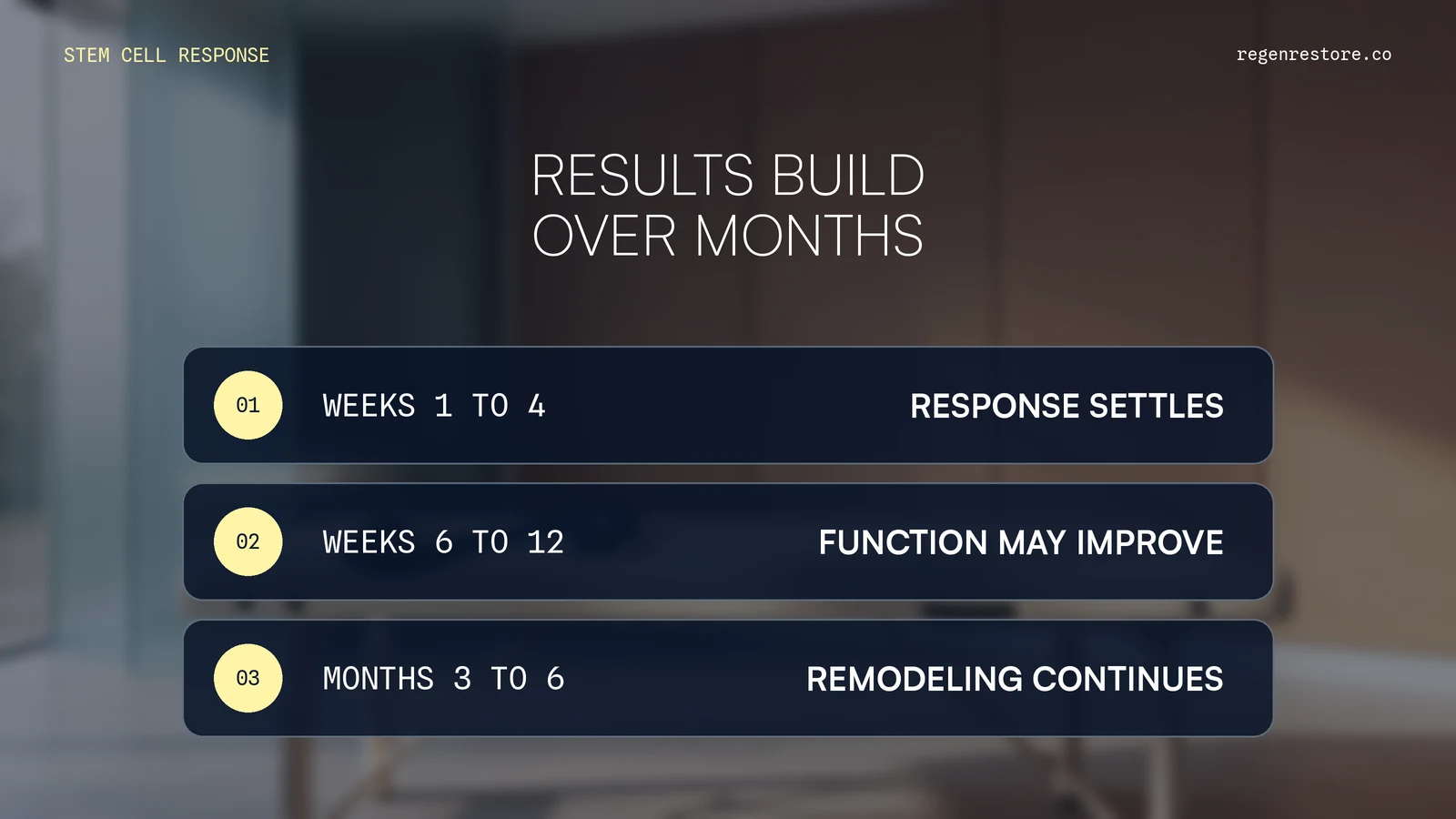
A typical response pattern runs across 3 stages.
- Weeks 1 to 4: inflammatory response settles, with symptoms sometimes temporarily worse.
- Weeks 6 to 12: functional improvement begins to register.
- Months 3 to 6: continued improvement as remodeling completes.
Patients expecting change in the first 2 weeks often conclude the treatment failed before it had a chance to work.
Does Image Guidance Change the Outcome?
Placement determines whether cells reach the target tissue at all. Ultrasound or fluoroscopic guidance confirms needle position in the joint space, tendon sheath, or disc rather than in surrounding tissue.
Unguided injection into a knee joint misses the target space more often than most patients would assume, which is why guidance is a reasonable requirement rather than an upsell.
How Does It Differ From a PRP Injection?
PRP concentrates platelets and the growth factors they carry from the patient’s own blood. Stem cell treatment introduces cells that produce signaling factors continuously over a period of days.
Three differences follow from that.
- Duration of signaling, which is brief with PRP and extended with cell-based treatment.
- Preparation, since PRP requires only a blood draw and centrifuge cycle.
- Cost, with PRP substantially lower per treatment.
Many patients begin with PRP and consider cell-based treatment only if the response is incomplete.
What Limits How Well It Works?
Four factors constrain response: the severity of existing degeneration, patient age, the local biological environment including smoking status and metabolic health, and the cell dose delivered.
Advanced structural disease has less tissue left to remodel, which is why regenerative treatment is not a substitute for joint replacement in late-stage cases.
Candidacy is determined at evaluation. Our stem cell treatment program includes imaging review and a written treatment plan, and the treatment overview appears in what is stem cell therapy.
Frequently Asked Questions
Do the injected cells stay in the joint permanently?
No. Most injected cells clear within weeks. The therapeutic effect comes from the signals released during that window rather than from long-term residence.
Is symptoms getting worse at first a bad sign?
A temporary increase in soreness and swelling during the first 1 to 2 weeks is common and reflects the inflammatory phase of the response. Symptoms that worsen progressively past 2 weeks warrant a call to the clinic.
Does a higher cell dose produce better results?
Dose appears to matter, though a defined optimal dose has not been established across applications. Cell count is one of the questions worth asking when comparing providers.
Can the treatment be repeated?
Yes. Repeat treatment is common when the first round produces partial response, and timing is typically assessed at the 3 to 6 month mark.